 On April 21, I delivered the open talk at Brock University's annual conference on world religions, with year's theme being "the problem of evil." The following is the full text of my lecture, which was abridged during the actual event due to time constraints.
 God’s Problem: When religion fails to answer the question of evil and suffering.
By Grant LaFleche
I may well be the oddest choice to present the opening talk on a conference about world religions.
This is not because I have no interest in the subject. Quite the opposite in fact. But rather because unlike every other speaker you will hear over the next two days, I don't believe in any of it. I'm an atheist, which means I don't believe the supernatural claims of religion are true. But even more than that, I am not just an atheist but also an anti-theist - which is to say that I am rather glad it isn't true. There are atheists who will say they wished they had the faith to believe in a god, or to believe the vision of the world as laid out in holy scriptures where true, but they just cannot believe it. This is decidedly not the case with me. As I say, I am rather glad it isn't true and if it were I am convinced we would all be the poorer for it.
Unlike the my colleagues who will take this stage after me, I will not tell you what a particular god wants. I make no claim to be able to offer some ultimate answer to the meaning of life or the nature of the universe which we inhabit. Like all legends and myths, religions say a great deal not about the nature of the universe, but about human nature. About those who wrote the scriptures and those who believe it.
So I want to begin today by talking about a legend you'll know well, a modern myth, about a saint in the world’s worst slums. A woman, so the story goes, so filled with the light of the divine that she devoted her life to working with the poorest of the poor, the most destitute and wretched of the human condition. She did so gladly and so selflessly that many believe Mother Teresa was a living example of the omni-benevolence of god and evidence of the affirming power of faith.
It’s a nice tale, isn’t it? But legends are tricky things and as Nehur said, “facts are facts and they do not disappear on account of your likes.” And the facts about Mother Teresa’s work in the Calcutta slums tell a different tale than her legend.
As Christopher Hitchens so clearly demonstrates, Teresa was not a friend to the poor, but a friend of poverty. She believed that the more one suffered, the closer one is to Jesus. Her order raised millions, but built no hospital nor improved her own hospices, enacted no programs to put an end to the horrid conditions that lead to many to live such wretched lives. Instead, she gave them a place to die – a place where medical science was shunned, hypodermic needles reused by running them under cold water and people died from treatable illnesses. Her theology, rooted in a very Catholic idea of the “mystery” and utility of suffering, required these poor people remains poor, ignorant and sick.
“I think it is very beautiful for the poor to accept their lot, to share with the passion of Christ,” she once told a journalist. “I think the world is being much helped by the suffering of the poor people.” Only one blinded by theology could make so wicked a pronouncement. Only credulity can make one believe it to be true.
How can anyone look into the face of an impoverished, dying person and say what they see is a good thing? It is not that Teresa was intentionally cruel. It is that she was utterly removed from the human condition by her faith’s inability to cope with the reality of human suffering. In some ways, she was a victim of hundreds of years of failure by theological and philosophical authorities to resolve what is sometimes called “the problem of evil.”
It is an old theological problem, one that predates the supposed birth of Jesus, and it asks a simple question: if there is an all powerful, all wise, all loving god that cares for mankind, why is there so much evil in the world? Why are human beings beset with so much suffering? The late novelist Joseph Heller described this enduring contradiction in Catch-22, when his sardonic hero John Yossarian gets into an argument with his lover about being thankful to god:
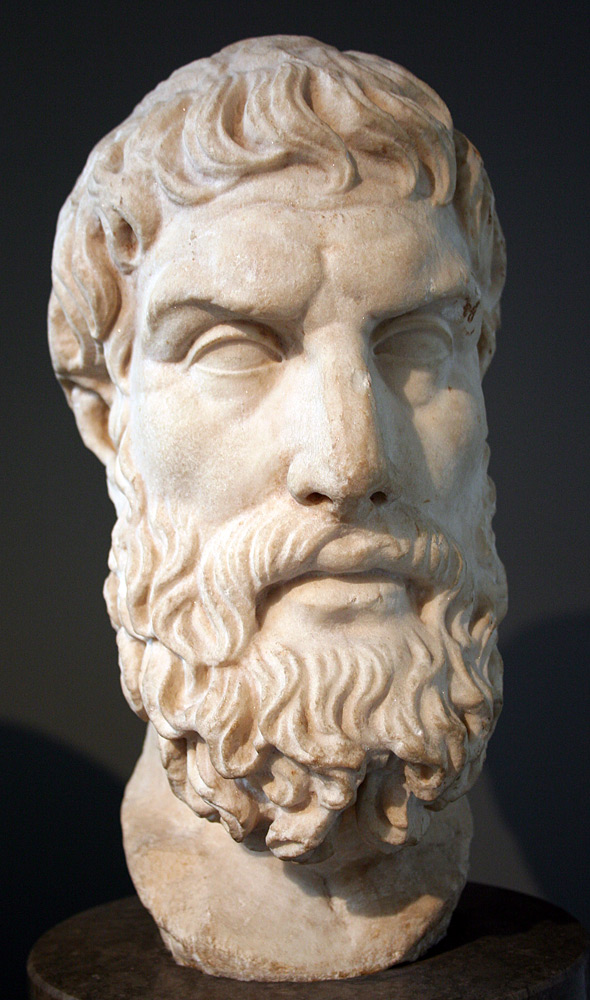
“And don’t tell me God works in mysterious ways,” Yossarian continued, hurtling on over her objection. “There’s nothing so mysterious about it. He’s not working at all. He’s playing. Or else He’s forgotten all about us. That’s the kind of God you people talk about – a country bumpkin, a clumsy, bungling, brainless, conceited, uncouth hayseed. Good God, how much reverence can you have for a Supreme Being who finds it necessary to include such phenomena as phlegm and tooth decay in His divine system of creation? What in the world was running through that warped, evil, scatological mind of His when He robbed old people of the power to control their bowel movements? Why in the world did he ever create pain?”The problem of evil was perhaps first put by a Greek thinker some 500 years before the birth of Jesus. Although Epicurus’ simple paradox lacks Heller’s singular wit, it remains as powerful and as unanswered today as it did when it was first posed:
“Pain?” Lieutenant Scheisskopf’s wife pounced upon the word victoriously. “Pain is a useful symptom. Pain is a warning to us of bodily dangers.”
“And who created the dangers?” Yossarian demanded. He laughed caustically. “Oh, He was really being charitable to us when He gave us pain! Why couldn’t He have used a doorbell instead to notify us, or one of his celestial choirs? Or a system of blue-and-red neon tubes right in the middle of each person’s forehead. Any jukebox manufacturer worth his salt could have done that. Why couldn’t He?”
“People would certainly look silly walking around with red neon tubes in the middle of their foreheads.”
“They certainly look beautiful now writhing in agony or stupefied with morphine, don’t they? What a colossal, immortal blunderer! When you consider the opportunity and power He had to really do a job, and then look at the stupid, ugly little mess He made of it instead, His sheer incompetence is almost staggering. It’s obvious He never met a payroll. Why, no self-respecting businessman would hire a bungler like Him as even a shipping clerk!”
Is God willing to prevent evil, but not able?
Then he is not omnipotent.
Is he able, but not willing?
Then he is malevolent.
Is he both able and willing?
Then whence cometh evil?
Is he neither able nor willing?
Then why call him God?
As the philosopher David Hume would note centuries later, “God’s power is infinite. Whatever he wills is executed but neither man nor other animals is happy. Therefore he does not will their happiness. Epicurus’ questions are yet unanswered….”
Attempts to resolve Epicurus’ riddle have occupied theologians since the dawn of the Christian era, and I submit have failed utterly. You will, through the course of this conference likely hear many of them. Free will is the usual fall back position – humans suffer because humans choose to inflict suffering. Great – except it is difficult to connect free will to an earthquake, flood or viral epidemic.
Others will claim original sin is the source of what ails us. Except we know there was no Adam and Eve that spawned the species – as any biologist can tell you, if there is only one mating pair of a mammalian species left, that species will quickly die out as inbred genetic defectives. In any case, condemning an entire species for the alleged crimes of two people is unjust and unloving by definition.
Still others attempt to say that god will eventually take care of evil after a bloody apocalypse in which man kind is judged. Fantastic, except that does nothing for those who have been ravaged by cancers or killed in wars. This also suggests, if true, a certain capriciousness and feckless morality to god. He could have prevented the deaths of six million Jews during the Holocaust, or other atrocities, but says instead “Ah, I’ll get around do something about this eventually.”
To make this point clear, let’s conduct a quick thought experiment. Imagine you are walking down the street and a man in front of you falls over from a heart attack. You are armed with a cell phone can with a call to 911 can save his life. Or you can walk away with the promise that at some point in the future, you’ll make a sizable donation to the Heart and Stroke foundation. The moral choice is obvious.
Others have simply abandoned the standard arguments, throw up their hands and say god MIGHT have a reason for letting horrors visit themselves upon mankind, but we just don’t know. And since we don’t know the mind of god, the problem of evil therefore solved. Well, this line is simply an appeal to ignorance to avoid the central question and a rephrasing of “god works in mysterious ways.” And we know what Yosarrian thought about that.
Some take Epicurus’s riddle to be such a damning argument as to demolish the very notion that an all powerful, all loving god even exists. That may be so, although on it’s own it does not dispense with the notion of any god, merely those purported to be all powerful, all knowing and all loving gods. It’s the fantastic dearth of evidence to back up the supernatural claims made by theistic religions is more than sufficient to dismiss them.
Indeed, it stretches credulity to accept the notion of god as Judaism, Christianity and Islam would have us believe. To borrow from Christopher Hitchens, what these religions are asking us to believe this: We know that as a species, human beings have been on this planet for between 100,000 and 200,000 years. If we use the lower figure and say 100,000 years, what the Abrahamic faiths would have us believe is that for 96,000 years or so the human condition was as Hobbes would describe it: nasty, brutish and short. We are killed by bacteria and viruses we don’t know are there, by weather and natural calamities we have no understanding off. Women routinely die in childbirth and life expectancy is less than 25 years. This is to say nothing of what people do to each other for food or land. Slowly over this period, however, by the sweat and toil of people, rise great civilizations in China, in India and in Greece. After all this, heaven decides it's time to intervene. And it does so consistently to illiterate, stupefied peasants in the middle east, rather than in part of the world where the message could be spread.
Indeed, the idea that god is all loving is undone not merely by critical examination, nor by Epicurus’s razor like paradox, but by the religious texts themselves.
In the Old Testament, for example, God murders often and in great numbers. He orders several ethnic cleansings, including a standing order to wipe out the town of any people who dare suggest to the Hebrews that they follow another god. He orders a father to murder his own son as test of loyalty and even personally commits genocide and ecocide on a global level. My own personal favorite is when god orders up a couple of nasty bears to tear 43 children apart for calling a bald man has no hair. Even if taken as metaphor, these are not stories about love, but about an uncontrollable, petty rage that would make even Zeus blush. Were such a god to actually exist, it would not be a creature to bow down to, but to openly oppose on basic notions of justice and human solidarity.
Even in the New Testament we see the contradiction continue. It is only in the New Testament that we are introduced to the utterly immoral concept of hell, where one can be tortured forever for rejecting god’s “love.” Where “salvation” comes in the form of a bloody human sacrifice that any of us would feel duty bound to stop if we had been there. It is made worse because the crucifixion would rob us of personal responsibility, upon which all ethics must be based, in favor of vicarious redemption. Indeed, I openly reject the “sacrifice” of Jesus. I would want no part of it, were it to be true, because I reject the notion that someone has to die for my alleged crimes.
However, as it seems on the weight of evidence obvious there is no reason to accept these claims about a god – as self contradictory as they are – why should I or any non-believer actually care about the problem of evil? It’s because the inability to reconcile the concept of god with the reality of suffering and evil leads, in far too many cases, to morally and ethically reprehensible behavior.
The most obvious results can be seen in the middle east, where honor killings still result the horrific deaths of innocent people, particularly women, for violations of religious laws. In parts of the Muslim world apostasy remains a capital offense. In Afghanistan, Muslim clerics recently sentenced a young couple to death for eloping contrary to their religious edicts. The growing imposition of the Sharia law in Afghanistan has resulted in a law making martial rape legal. You see the point. Only when one’s views are so utterly removed from the reality of human suffering can one seriously make a claim that a wife must provide sex to her husband upon demand. Some niceties do exist, however, in the minds of gruesome Muslim clerics with little sense of compassion. One claims that a wife can say no - but if she does then her husband has the right to starve her.
But the western world should not be so smug. Recently, the Pope declared that condoms make the AIDS epidemic worse in Africa – a continent where more than 25 million have died from the illness and millions more are infected. We know beyond any shadow of a doubt, thanks to science, that condoms have a significant impact in reducing the spread of this virus, yet the church sees fit to ignore this and reject it as a theological issue – which has a significant impact in Africa where the words of a pope carry significant weight. The church’s position is plainly wicked because it contributes to suffering and death. No amount of declaring it to be a faith issue, and thus beyond reproach, can change that.
Where the secular humanist will examine the issue from a utilitarian perspective with an aim of reliving suffering, the church is irrationally dogmatic and dismissive of evidence.
This was powerfully seen only last month in Brazil during the aftermath of the rape of a 9-year-old girl by her step father. He had apparently been abusing her for three years and she ended up pregnant. With twins. At 9-years-old. Her doctors said she would not survive carrying the babies to term, let alone deliver them. Now, in Brazil, abortion is only legal in rape cases and if the pregnancy threatens the life of the mother. This qualified as both and the courts granted permission for the procedure.
The church’s reaction to this? Not concern for the suffering this poor child has endured at the hands of a rapist, nor the suffering she will continue to live with for much of her life, but with the abortion. Because the Vatican has declared it a sin. So they petition the courts to deny the abortion claiming the babies could be delivered via c-section. Never mind these bishops are not medical doctors, and are not considering the mortal danger the child is in.
When that failed, the church excommunicated the girl’s mother, lawyers, and doctors. They saved her life, but they have been drummed out of the church. No big deal for non-believers but catastrophic for those who do. They would have thrown the girl out to, but apparently the Vatican as a rule against excommunicating minors.
By the way, just to add insult to injury here – guess who was NOT excommunicated? The rapist step father– the criminal who set off a chain of suffering with his evil actions. A chain the church, because it fails to grasp the reality of suffering – has helped perpetuate.
Human beings suffer. We cannot avoid it. We commit evil acts. This is not because we are made to suffer to allowed to by a divine hand be it caring or capricious. It is because we live on a planet with a shifting crust and powerful weather systems that orbits a start that bathes the planet in radiation – a star that will eventually burn itself out and take this entire planet with it.
We suffer because we are a product of an unguided evolutionary process that shapes all life on this planet, one that does not work from blueprints, but jury gigs systems from the materials at hand. That life can be benign, like a tree, or lethal, like insects that eat other organisms from the inside out. In our case we continue to carry what Darwin called the lowly stamp of our origins. For all our intelligence and brilliance we are still at the mercy of urges, defects, and instincts. And yes, we suffer because of our choices.
How do we best respond to both those forces, both within our control and beyond it? We do so by recognizing not that suffering is part of a grand plan, but something we can combat. We feed the hungry. We provide proper medical care to the sick. We do not fret and worry about the destination of souls or the hereafter. We help each other in the here and now.
Nor do we treat evil as something divine or that exists with a greater moral justification we just don’t understand. We fight it. We certainly do not follow the words of Jesus who, according to the Gospel of Matthew, counsels us to “not resist and evil person.” This hopelessly naive view would allow the Hitlers and Osama Bin Laden’s of history to burn civilization to the ground. Or to put this another way: the choice not to resist evil is a choice to allow it to flourish. In our own life times, the example of the Rwandan genocide should serve as a powerful reminder of what happens when evil is not resisted. Mountains of bodies and rivers of blood are the logical end result of putting Jesus’ doctrine into practice.
The world is not much helped by the suffering of poor people. To truly face human suffering and deal with it as such we must abandon the confused and contradictory theologies that would distance us from it. Rather we can walk the path of a much greater and humane tradition than what is found in the Bible or the Koran. The Greeks had a basic moral and ethical idea that can be expressed as “Be careful whom you turn from your door.” It is famously the operating ethical system of Homer’s Odyssey. And it says that you help your fellow creatures in need because one day you might be the one who will survive on the charity of strangers. Human solidarity, as expressed in this fashion, gets us a very long way to creating a better society for everyone.
It is not perfect. We will stumble. We will fail. But that is almost the point, that we struggle knowing this to be so. And knowing this is the only life we have, that we will cease to exist when we die as we did not exist before we were born, means we have this one and only chance to make a difference.
Grappling with evil and suffering and lending aid to our fellow creatures is something that we, believer and non-believer alike, should gladly do. But never should we treat suffering as mysterious, unassailable or worse, as something good.


 Posts
Posts